
Assembly technician
Assembly technician roles in the Netherlands are in steady international demand, and Dutch manufacturers are actively seeking European candidates, including those from Greece. The production sector runs on skilled hands, and if you have technical training or shop-floor experience as a production assembler or electronics assembler, you’re already a strong candidate for roles that pay significantly more than comparable work back home.
This article covers what you’ll actually do on the job, which skills and credentials matter to Dutch employers, what the salary looks like compared to Greece, where the work is concentrated, and the steps to go from interested to employed. You don’t need to speak Dutch to get started. By the end, you’ll have a complete picture, not just a job description.
GO Jobs has a special and proven process to get you successfully setup for your new job in Holland. Read more on this GO Jobs Roadmap.

What does an Assembly technician do
PCB assembly technician tasks: building, soldering, wiring, and checking quality
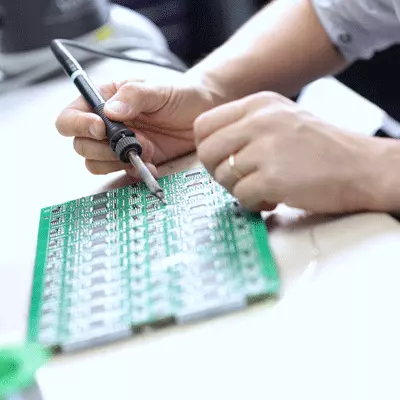
The core of the job is physical: assembling PCBs or mechanical subassemblies, soldering SMT and through-hole components, building wire harnesses, crimping connectors, and fitting parts together according to spec. After assembly, you inspect your own work, checking solder quality, component alignment, clearances, and mechanical fit. Functional testing follows, using multimeters, test fixtures, or software-driven test stations to confirm the unit performs correctly before it moves to the next stage. Fine motor skills and consistent attention to detail matter just as much as any certification at this stage of the work.
Documenting results and preparing units for shipment
Nothing leaves the line without a record. Assembly technicians log test results, report deviations from specification, rework faulty units when required, and prepare finished products for packaging and dispatch. Maintaining an ESD-safe, organized workspace is standard throughout the shift, not an occasional checklist item. Employers track output and quality closely, and the documentation you produce is part of that traceability system.
Skills and qualifications Dutch employers want from assembly candidates
Dutch manufacturing employers are practical. They’re not looking for impressive-sounding degrees; they’re looking for candidates who can demonstrate real ability, pass a skills test, and hit the ground running. Understanding what belongs on your CV, and what you’ll face in an assessment, puts you well ahead of applicants who apply without preparation.
Please contact the recruiter if you want to know more on a specific position you want to apply for.
Active Jobs we Hire for
Curious for the active jobs at the customers we currently hire for? Click the button below and see the active jobs. Please feel free to Contact us if you can not find the job you are looking for. So we can help you further.
Technical skills that belong on every CV
- The skills that get candidates shortlisted in the Netherlands consistently include soldering (both hand soldering and SMT), cable and harness assembly, multimeter use, ESD-safe handling procedures, and the ability to read wiring diagrams and assembly drawings. If you’ve worked with test fixtures, oscilloscopes, or automated inspection equipment, list those too.
- Soldering: hand soldering and SMTCable and harness assembly
- Multimeter and basic test-equipment use
- ESD-safe handling procedures
- Reading wiring diagrams and assembly drawings
- Test fixtures, oscilloscopes, or automated inspection equipment (where applicable)
Concrete, specific experience beats vague claims every time, so write “assembled SMT PCBs using J-STD-001 process guidelines” rather than “experience with electronics.”
Production line technician vs. assembly operator, what employers expect from certifications
IPC-A-610 (the electronics assembly quality standard) and J-STD-001 (the soldering process standard) are internationally recognized and commonly relevant to electronics employers across the Netherlands. Greek candidates who hold or are working toward these credentials signal immediately that they understand production-grade quality requirements. Both certifications are obtained through IPC-authorized training centers; the CIS (Certified IPC Specialist) route typically takes three to four days of training followed by a practical exam, and certification is valid for two years. Vocational qualifications from Greek IEK programs in electronics, mechatronics, or related technical fields provide relevant structured training that can strengthen your application, subject to individual employer evaluation.
What to expect in a skills test
Many Dutch employers run a short practical assessment before making an offer. Expect to produce clean solder joints, correctly place and orient components, use a multimeter for continuity testing, read a schematic, and demonstrate ESD-safe habits throughout. Preparing for these specific tasks, rather than reviewing theory, is what gets candidates through the hiring process. If you can perform them confidently and cleanly, the assessment is straightforward.
What assembly technicians earn in the Netherlands
The salary question is usually the first thing Greek candidates ask. The gap between Greece and the Netherlands for this kind of work is significant and real, and the numbers below show why so many production assemblers and manufacturing technicians make the move.
The Greek salary reality in assembly and production
Assembly technicians in Greece typically earn between roughly €975 and €2,054 gross per month, depending on sector, employer, and experience. The broader manufacturing technician average sits around €1,390 gross per month. Benefits like housing or transport allowances are sometimes folded into that figure rather than paid separately, which means the net take-home is lower than it might appear at first.
What the Dutch labour market pays for the same work
In the Netherlands, assembly technician roles typically start at or above the national minimum wage. According to the Dutch government’s official wage figures, the statutory minimum wage in 2026 sits above €2,200 gross per month. Evening and weekend shift allowances add further to that figure. The net take-home is competitive because the Dutch tax system is transparent and well-structured. Some international hires may also qualify for the 30% ruling, a tax facility that reduces taxable income during the initial years of residence in the Netherlands for eligible workers; candidates should verify their eligibility directly with a Dutch tax adviser or the Belastingdienst.
Which Dutch industries and regions are actively hiring assembly workers
Understanding where demand is concentrated helps you target your application and gives you a realistic picture of where you’ll be living and working once placed.
Sectors with consistent demand for assembly technicians
The Netherlands has active hiring across automotive manufacturing, electronics and PCB production, medical device assembly, and industrial machinery. Companies like VDL Groep, DAF Trucks, ASML, NXP Semiconductors, and Philips Medical Systems run multi-shift production lines and recruit internationally to fill skilled assembly operator and production line technician roles. Domestic labour supply in technical trades remains tight, which is precisely why employers look beyond Dutch borders for qualified candidates.
Where the jobs are concentrated geographically
North Brabant, centered on the Eindhoven and Helmond region, is the single strongest hiring cluster for assembly and production work. According to Brainport Eindhoven data, the province accounts for a substantial share of Dutch high-tech systems and materials employment. South Holland’s Rotterdam industrial belt, Gelderland (including Nijmegen), and the broader Randstad industrial corridor also have consistent hiring activity. For Greek candidates relocating for the first time, working with a specialist recruiter that has established employer relationships across these regions, and can support practical relocation steps like housing arrangements and administrative setup, removes much of the guesswork from choosing where to land. Go Jobs Holland works with Dutch manufacturers across these areas and can provide that regional guidance.
How to go from Greece to a Dutch assembly technician role
The path is well-established, and Greek candidates are not starting from zero. EU citizenship means no work permit is required; you can work in the Netherlands on the same basis as Dutch citizens. A clear process and the right support are what make the difference.
Preparing your application before you reach out
Update your CV to highlight hands-on assembly experience in specific terms: which components, which tools, which standards you’ve worked with. Add any IPC, IEK, or technical vocational credentials in a prominent position. A short English-language CV, two to three pages maximum, formatted to European standards, is all most Dutch employers ask for at the application stage. No Dutch required. On the question of photos, Dutch employer preferences vary; many recruiters recommend omitting a photo to keep the focus on your technical credentials, so check the specific employer or recruiter guidance before including one.
Using a specialist recruiter to shortcut the process
Applying independently to Dutch manufacturers from Greece means navigating unfamiliar job portals, translation barriers, and employer expectations without any local context. Go Jobs Holland recruits European candidates, including Greeks, for production and assembly roles with Dutch manufacturers. The process begins with a face-to-face or video introduction, moves to matching candidates with the right employer, and includes support with housing and administrative setup in the Netherlands. Most production environments operate in English at the floor level for international hires, so you don’t need Dutch before you start. The language comes with time; the job doesn’t wait for it. Get in touch with Go Jobs Holland to find out which roles are currently open.
What happens after you get the job offer
Once placed, the core administrative steps are registering at your local municipality, applying for a BSN number (the Dutch citizen service number, which unlocks payroll, healthcare, and banking), and setting up mandatory Dutch health insurance. An experienced recruiter knows exactly how to walk you through these steps in sequence. Your first week should be about getting to work, not getting lost in paperwork.
The bottom line for Greek candidates ready to make the move
Assembly technicians in the Netherlands do skilled, structured work that builds directly on technical training and hands-on experience, Dutch fluency is not the entry requirement. The salary gap between Greece and the Netherlands for this type of work is substantial: roughly double the gross monthly pay in many cases, with shift allowances and a structured tax system on top of that. Current hiring across automotive, electronics, and medical device manufacturing reflects strong ongoing demand from Dutch employers.
The practical path from Greece to a Dutch assembly technician role is clear and well-traveled for candidates who approach it correctly. Greek EU citizenship removes the work-permit barrier entirely. A solid CV, the right credentials highlighted, and a direct connection to employers through a recruiter who knows both the candidate pool and the Dutch market is what turns interest into a signed contract. Go Jobs Holland supports that process with direct employer relationships, honest expectations, and practical help at every step. Ready to take the next step? Reach out today and apply for open assembly roles in the Netherlands.
Active Jobs we Hire for
Curious for the active jobs at the customers we currently hire for? Click the button below and see the active jobs. Please feel free to Contact us if you can not find the job you are looking for. So we can help you further.
The GO Jobs Process – make it easy
At GO Jobs we are specialized in helping Greek professionals in finding their new career in the Netherlands. We will make it easy for you to find the job you want and we help you even with the rest. We take the extra step. Based on our proven process we help you with housing and mobility. Our Welcome team is there to support you, to support you to achieve success and to expand the GO jobs family.
Read more on the GO Jobs process
What is vocational education?
Vocational education, also known as career and technical education (CTE), is a type of education that focuses on teaching the skills, knowledge, and training needed for specific careers or trades. It is designed to provide students with the practical skills and experience needed for a particular job or field, rather than a general education.
Vocational education programs can be found at the secondary, post-secondary and adult education level. The programs can be offered in high schools, vocational or technical schools, community colleges and trade schools. The programs can also be offered in an apprenticeship format, where students learn on-the-job while working with experienced professionals.
Vocational education can include a wide range of fields such as healthcare, manufacturing, construction, automotive, and information technology, among others. The curriculum is designed to provide students with hands-on training and real-world experience, which can include laboratory work, internships, and apprenticeships.
Vocational education is often seen as an alternative to traditional four-year college education, and it can be a cost-effective way to learn a trade or skill. Graduates of vocational education programs can find jobs in a wide range of industries, and they may have the opportunity to advance in their careers and earn higher salaries than those without vocational education.
Our Socials
Connect with us
In the realization of this website, AI support was used for some parts. AI can be used for the realization of pictures, images and / or texts on the website.